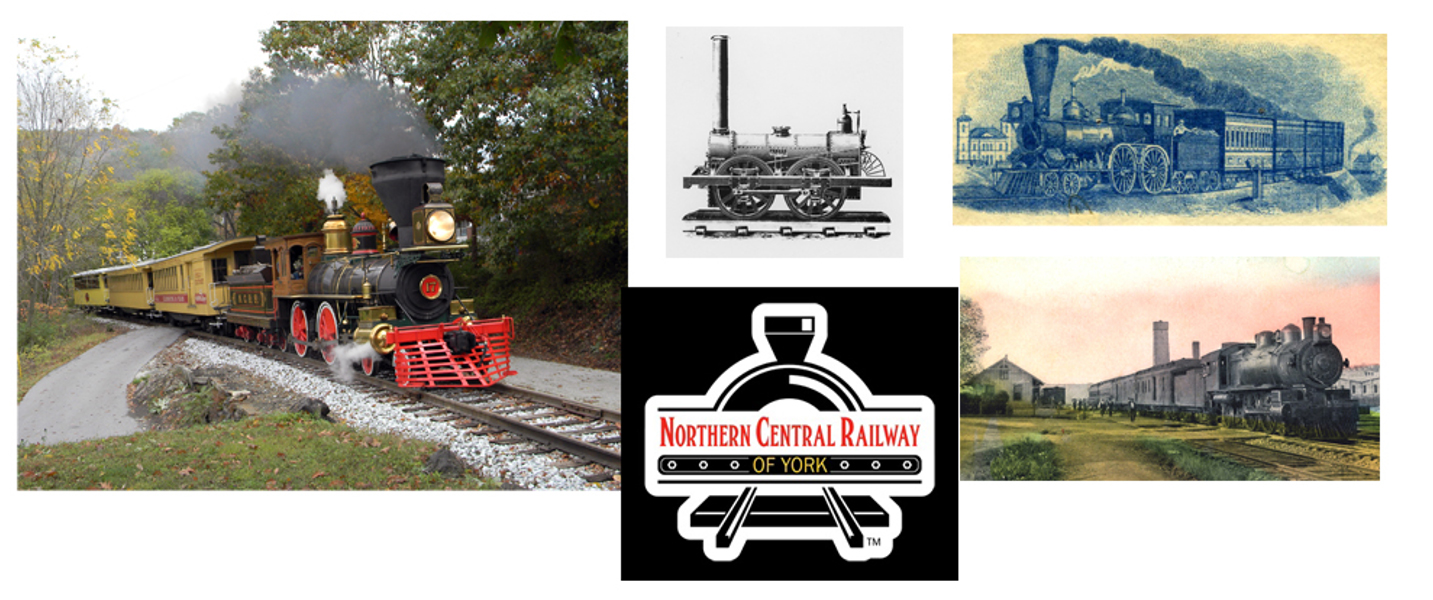
Our Nation’s great railroad network has captivated the masses since the first puff of smoke rose from the tall stacks of the early steam locomotives, 195 years ago. Significantly, the second-oldest railroad in the US was the first segment of today’s Northern Central Railway of York. On February 13, 1828, the Baltimore & Susquehanna Railroad was incorporated. The goal of businessmen from York County, PA, and Baltimore was to link the Susquehanna River valley at Columbia with the Port of Baltimore. Later, the line expanded north to Harrisburg and Sunbury, PA. In 1854, the Baltimore & Susquehanna merged with three other subsidiaries to form the Northern Central Railway (NCR).
Progress
 The progress of the NCR was steady, and the railroad captured the attention of the expansionistic Pennsylvania Railroad (PRR). Between 1861 and 1870, the PRR acquired a controlling interest in the NCR and finally entered into a long-term lease in 1914. PRR invested heavily in the NCR, and it became a viable competitor of the Baltimore & Ohio for traffic to the west. Significantly, the PRR was then the largest railroad in the US.
Those were the best of times along the NCR line, a route that was truly the mainline of commerce in the earliest development of the eastern US. Residents of York County had the services of one of the best-equipped railroads in the Nation, a fact proven by the quality of traffic and the strategic importance of the NCR. Records indicate that President John Tyler traveled through New Freedom on June 8, 1843, followed by President-elect James Buchanan on March 2, 1857. President Abraham Lincoln passed through town on November 8, 1863, en route to Gettysburg, PA. Additionally, the NCR saw funeral trains that carried the remains of Presidents Zachary Taylor (1850), Abraham Lincoln (1865), James Garfield (1881), William McKinley (1901), and Warren G. Harding (1923) westward for burial. But it was the passenger trains and freight trains of all classes and descriptions that were the lifeblood of the communities along the NCR. The action occurred at the depot, where any journey, whether local or long-distance, began. The depot was also the place where the products manufactured or harvested by a community went to market. The depot was the communications center for the town as well. If you passed the depot late at night, the sight of the agent-operator pounding out messages on his telegraph key was a reminder that the depot was a place where service never slept.
All crew members, staff, officers, and directors of the Northern Central Railway of York believe in that rich heritage and the importance of sharing that with passengers today. Our equipment covers the broad expanse of that historical journey from locomotive #17 and a train of Civil War-era coaches to our more current diesel-electric locomotive and 1950s-era luxury passenger cars. Our roster also includes a caboose and several open cars so that you can experience another dimension of a ride along one of the most scenic routes in the East. Just like the pioneer NCR, we are committed to the communities we serve by incorporating local venues and the popular NCR Trail in our weekly railroad service and special, feature trains.
Nation’s Great Railroad
We hope you include a trip on our railroad in your travel and entertainment plans, and we hope you subscribe to our newsletter to witness our continued progress and creativity in our goal of improving our railroad service. We constantly update that with special trains and events throughout the year and plan additional postings about our rich NCR history and soon, events leading up to the 200th anniversary of American Railroading in 2027. Thank you for your continued patronage!
Frank Wrabel
Northern Central Railway of York