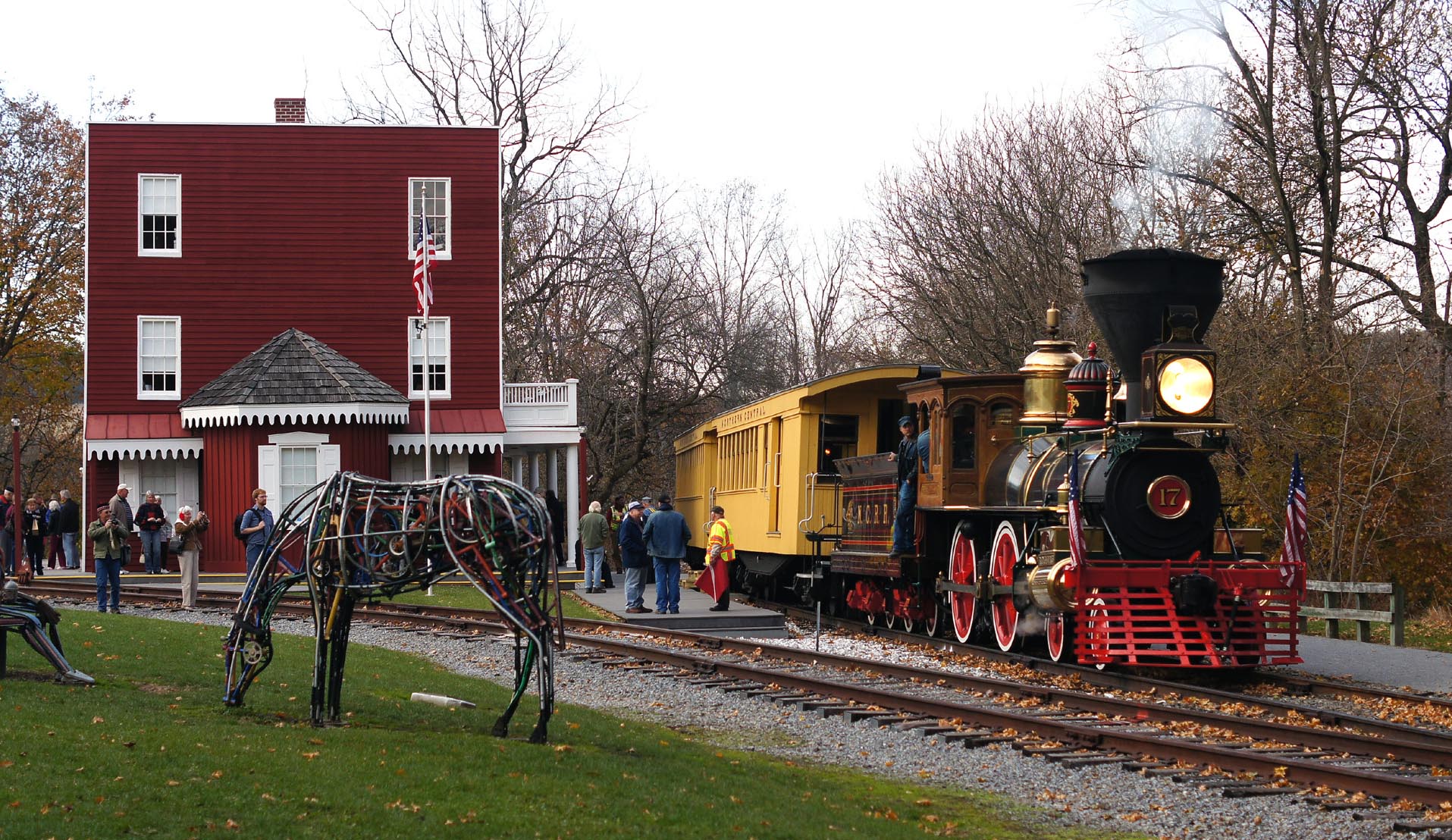
The golden rays of October sunlight dramatize both the beauty and the historical importance of the NCR line. The path from the MD-PA state line north covers some of the most beautiful and scenic land in the east. That area, and land just to the east toward the Susquehanna River, was once considered to also be the most fertile and productive “growing regions” in our great Nation. When NCR line was part of a through route from Washington to the west, passengers on speeding trains could look out from their coach seat or pause from dinner in the dining car to see the last traces of bountiful harvest and, later, corn stalks gathered on the golden hillside basking in autumn glory.
In the era
 In the era when getting there – by train – was half the fun, many travelers simply chose a day trip from Baltimore to Harrisburg and return each fall just to experience the beauty of those commanding vistas. Railroaders respected those “short hauls” – frequently referred to as “day trippers” – since they added to the greater income of passenger traffic and kept the name of the railroad in the forefront – a critical goal when the highways started to siphon off rail passengers after 1920.
That beauty took second place during the desperate years of the Civil War. On November 18, 1863, President Abraham Lincoln traveled from Washington to Gettysburg. The special train used the B&O line from Washington to Baltimore, where the cars were forwarded to the Northern Central Railway for the second portion from Baltimore to Hanover Junction, PA. At that junction, the Hanover Branch Railroad went west to Gettysburg, where the President would deliver his famous Gettysburg Address, to dedicate the Soldier’s National Cemetery for the brave souls that lost their lives at that location July 1 st through 3 rd , 1863.
Much has changed
Much has changed in our culture and society since those gripping events of the Civil War. In terms of local and railroad history, the route from Hanover Junction west eventually became part of the Western Maryland Railway, but the WM abandoned the eastern portion of the line into Hanover Junction between 1928 and 1930. (Historians rightfully claim the Hanover Branch Railroad to be the oldest portion of entire WM Ry.) The mighty Pennsylvania Railroad gradually acquired a controlling interest in the NCR, finally leasing it in 1914 for 999 years. But by the 1960s, PRR fortunes fell, an ill-fated and ill-planned merger with the New York Central to form Penn Central Transportation Company failed badly and by 1972, the NCR line – damaged by tropical Storm Agnes – was out of service and was declared surplus.
Those changes serve as a backdrop and add depth to today’s Northern Central Railway of York, and with a deep sense of respect and pride for our revered National heritage, we call your attention to the surviving station and hotel at Hanover Junction – the very same depot where President Lincoln changed trains back in 1863. That station – professionally restored to appear as it did on November 18th, 1863 – is one of several destinations we offer in our mix of varied train schedules and services – all positioned to provide you with many options to fully embrace the autumn glory of fall, along one of the scenic attractions of the east, in several ways that will surely please families and friends alike.
Please take time to review all the special features we offer, as well as the regular excursion trains, and check this site frequently for added events and special promotions. Most of all, we thank you for your patronage. Just like the “day trippers” of years gone by, your support is critical to making these memorable journeys by rail possible now and for years to come.
Frank Wrabel
Northern Central Railway of York